
This week we wrapped up a course at a software company. On the last day, one of the participants — a kind woman — told us about an experience she'd had after her morning meditation. She began by saying how grateful she was for it — and even then I had a feeling I knew what she was going to say.
As on every day of the course, that morning she sat down and practiced the effortless technique of transcending. Then, as she came out of the meditation and everything started up around her again — colleagues, tasks, family, the familiar noise — she noticed that something had changed. She felt her awareness had cleared, and she saw the world differently too. As if everything had become a little more beautiful. Her little child even remarked, “how beautiful you are, Mum,” and twice that day said “I love you” — which isn't all that common — she recounted, almost glowing.
This isn't the first time we've heard something like this from meditators — sometimes a similar experience comes up as early as the first days of the course.
And I'm convinced this isn't only a modern experience: people most likely felt the very same thing thousands of years ago — and not only in India.
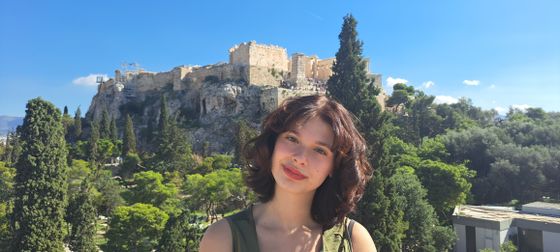
Athens, Greece
A few months ago I was in Athens, Greece, on a father–daughter trip. Fanni and I had been planning for a long time to explore this ancient city.
We also went to see the site of Plato's Academy. It's in a park, and honestly only a few ruins are left of it.
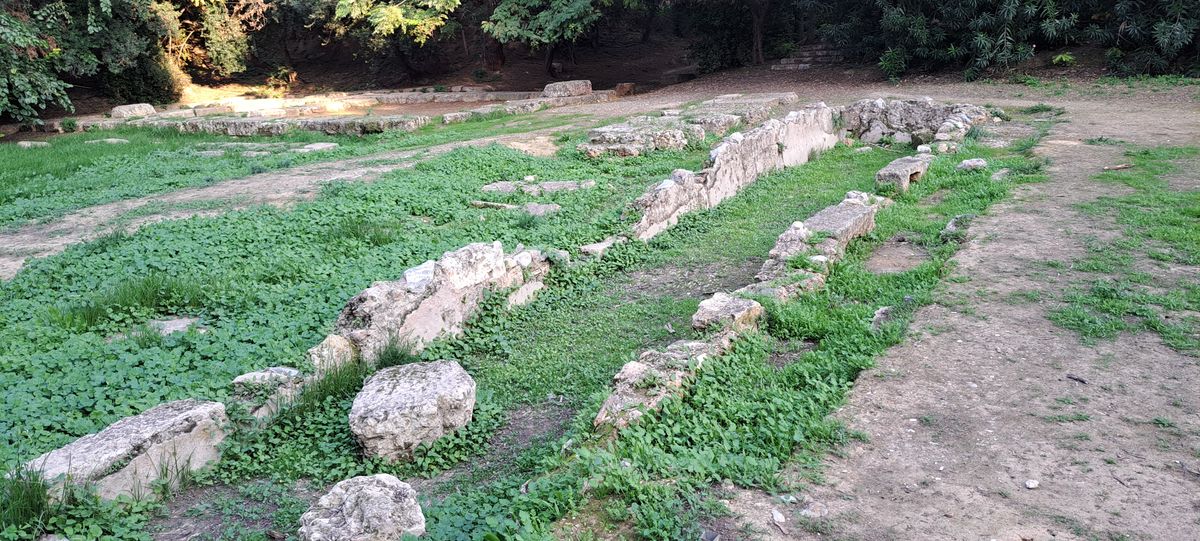
I imagined Plato and his students living there roughly two thousand four hundred years ago: wrestling, doing mathematics, eating well, and philosophizing about the great questions of life and the decline of democracy. (I didn't even know that the name “Plato” means “broad-shouldered” — tradition says his wrestling coach gave it to him because of his sturdy build; his original name was Aristocles. So one of the fathers of Western philosophy was originally named after the width of his shoulders — somehow that got left out of the school curriculum.)
There, among the ruins, the famous allegory of the cave came to mind. I suppose that, like every good teacher, he too tried to convey the reality of life through images and analogies.
Plato's famous allegory of the cave
Plato writes about a cave. People sit deep inside it, chained, facing the wall. Behind them a fire burns, and the shadows of objects are cast onto the wall. They have never seen anything else — for them, this wall is the whole of reality. And not out of stupidity: they know the shadows so well that they compete over who can better predict the movement of the next shadow.
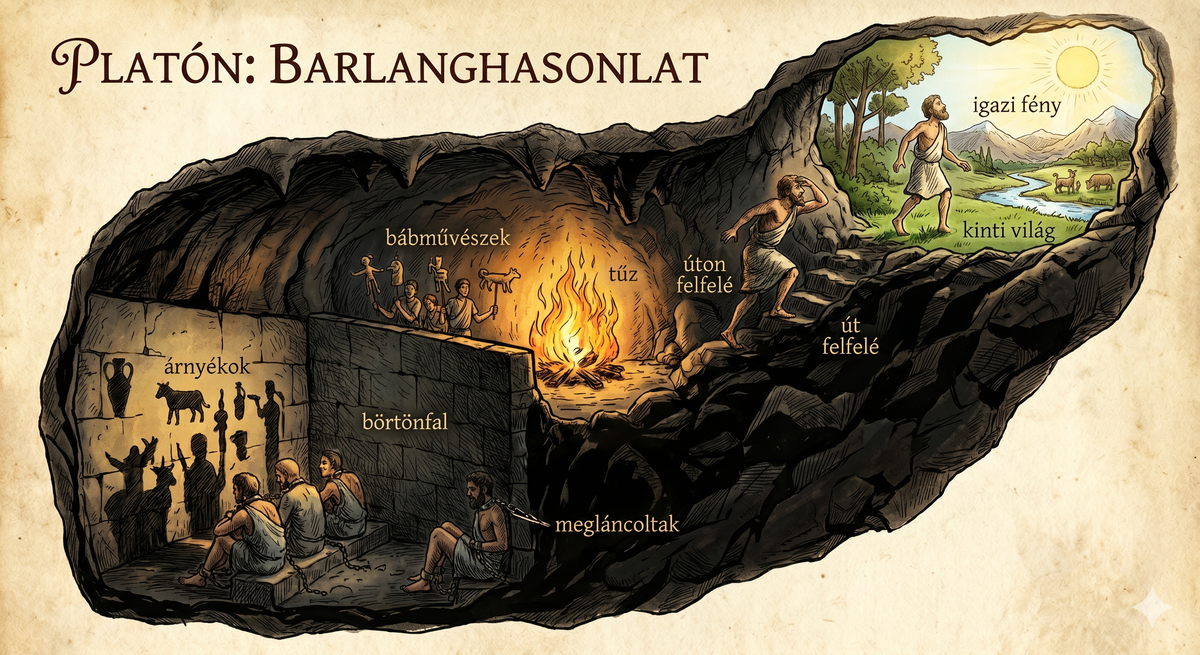
For Plato, the way out leads outward and upward: beyond the cave, into the sunlight, toward the true forms of things. If a prisoner breaks free and turns around, his eyes slowly adjust to the light, and he realizes: what he had taken for reality was only a shadow on the wall. Not a lie — just a narrow sliver of reality. With this realization he returns, to help the others. Of course this doesn't go easily — but that's a detail. :)
(Plato's own teacher, Socrates, who was working precisely on awakening people, was for instance sentenced to death. Plato was deeply disillusioned with Athenian democracy for doing this to their wisest teacher.)
In any case, it's a vivid image of how preoccupied we are with the shadows — the daily chores, tasks, thoughts, emotions — in the hamster wheel. And sometimes we're good at it; but there's still more to life.
The lesson of the allegory: the “turning around”
What does this allegory teach? Many have analyzed it in many ways, but Plato himself expresses it with a Greek word: periagogé (περιαγωγή), meaning “turning around”. What he writes is quite surprising. In his view, teaching is not about pouring knowledge into a soul that lacks it — it's not as if we were giving sight to a blind eye that cannot see.
The eye already sees; it's just looking the wrong way. To find release we don't need to acquire a new faculty; we need to turn the whole soul around, so that its existing sight turns away from the shadows, toward the light.
The original Greek word doesn't tell us which way to turn — only that the whole soul should turn. In the allegory, Plato turns it outward, along the sometimes rough and arduous path of pure understanding and logic.
It seems to me that the very same turn is also profoundly true inward — and I'm not alone in this: Plotinus already — one of the last great ancient philosophers, nearly 600 years after Plato — carried the thought further and taught: “do not set out outward, but withdraw into yourself, and look there.”
Beneath the noise of thoughts there is a silent, alert state of awareness, beyond the limits of thought. During transcending, the mind arrives at ever finer levels, then steps beyond the finest level of thought.
It's not a new experience to be acquired, but our most fundamental state, hidden by the bustle of the surface. I can't help connecting this with Plato's motif of “stepping out into the light.”
From here I'd return to that woman, who described all of this not in philosophical terms but with the joy visible on her face. She didn't say “I experienced periagogé”; she simply spoke about seeing the same day differently. And perhaps that's exactly what's beautiful about it: the allegory of the cave didn't become a philosophical thesis, but the experience of an ordinary morning.
Because that day, for a while, the woman left the cave.
Then she went back among her colleagues — to the same office, the same deadlines, the same familiar tasks — but she returned with this experience and a new enthusiasm. The shadows lost their limiting power. Perhaps they even grew more beautiful.