

Coping in the modern world
Modern humans often live as if we constantly had to flee or defend ourselves — even though, on the surface, nothing dramatic is threatening us. An email. A deadline. An inner sentence: “I’m not good enough.” The body often doesn’t treat these as philosophical problems but as danger. And in those moments, the ancient survival program kicks in: the fight-or-flight response.
The ancient survival system lives on inside us
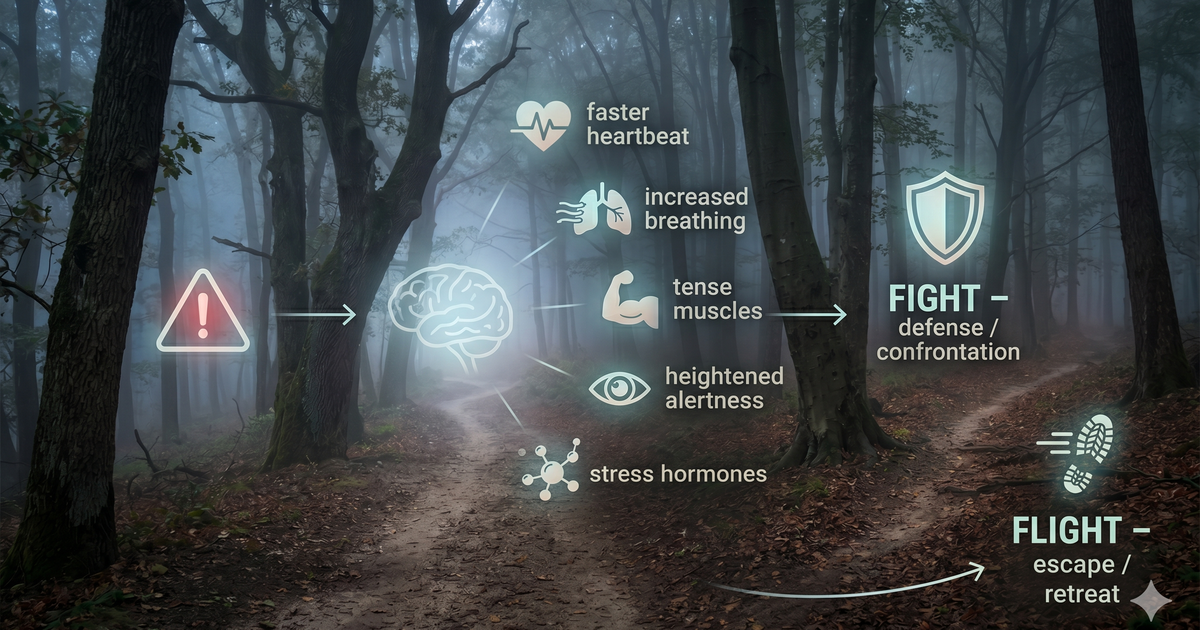
The expression is vivid: when the brain senses danger, the body mobilizes quickly. Either we fight the threat or we run from it.
Science today describes this in more nuanced terms. Under stress, the sympathetic nervous system and the adrenaline–noradrenaline axis activate, and during prolonged stress the HPA axis kicks in too. Heart rate and breathing accelerate, muscles tense, attention narrows. (NCBI)
In the short term, this is brilliant. For our ancestors, it was life-saving: if a predator appeared in the bushes, what was needed wasn’t self-reflection but an instant reaction.
When the caveman gets the keyboard
Under stress, it’s often not our wisest part sitting at the inner control panel. It’s more like our prehistoric ancestor suddenly being handed the laptop, the car keys, and the family WhatsApp group.
He’s not necessarily the best person to handle them. He responded brilliantly when something rustled in the bushes — but to an ambiguous email he sometimes fires off too strong a reply. We’re not bad people in those moments: it’s just a very old system trying to solve a very modern problem. And the higher the baseline tension, the more easily control slips back to this ancient mechanism.
Baseline tension: same stress, different reaction
It’s not just how much stress hits us that matters — it’s also what baseline state it finds us in.
It’s like a nearly full glass: a single drop is enough to make it overflow. Only into the modern person’s glass goes not just water, but deadlines, emails, family logistics, traffic, bills, notifications — and even the nagging thought, “oh no, I forgot to reply to someone again.”
Then someone comes along and asks: “Could you do this today?” And the glass doesn’t say, “Of course, I’ll think it through” — it erupts like a geyser.
But if the baseline tension is lower, the same stressor lands very differently. Here’s a letter we received recently:
Dear Andi and Tóni, 🙂
I’ve been meaning to write to you for quite a while. It’s now almost two months since the TM course, and I really wanted to share how this period has unfolded for me, what I’ve experienced with the practice, and how much it has given me.
I practice every day — I haven’t missed a single session — and I’m honestly amazed by how quickly and deeply I feel TM’s positive effects.
I’ve become much calmer, more balanced, and at the same time more energetic. My stress level has noticeably dropped; at home and in everyday life, everything has become much, much easier and smoother. Somehow everything feels less heavy on the inside.
It’s especially interesting to be living this now, because I’m facing a very big change: from June, my workplace of 29 years is closing. Knowing my old self, this probably would have completely thrown me off, and I would have been anxious and stressed about it for months. But now I feel there is a more stable inner calm and trust inside me. I’m not looking at the new period with fear — I’m actually curious about what it will bring… 🙂
I am endlessly grateful to you for this technique. I truly feel every day that something good and important has been set in motion inside me through TM. 🤍🤍
With love, Ani
What do we see during TM practice?
When someone starts practicing TM, an infinitely simple thing happens: the body finally begins to rest deeply.
Everyone experiences it differently. Some feel great calm, some only notice they react less explosively, some sleep better, and some say: “it’s as if there were a little space between me and my problems.”
Research approaches this from the physiological side as well. Early physiological studies on TM found, as far back as 1970, that during practice oxygen consumption and heart rate dropped while skin resistance rose — meaning several physiological markers moved in the opposite direction of the stress response. (PubMed) This is often described as a state of restful alertness.
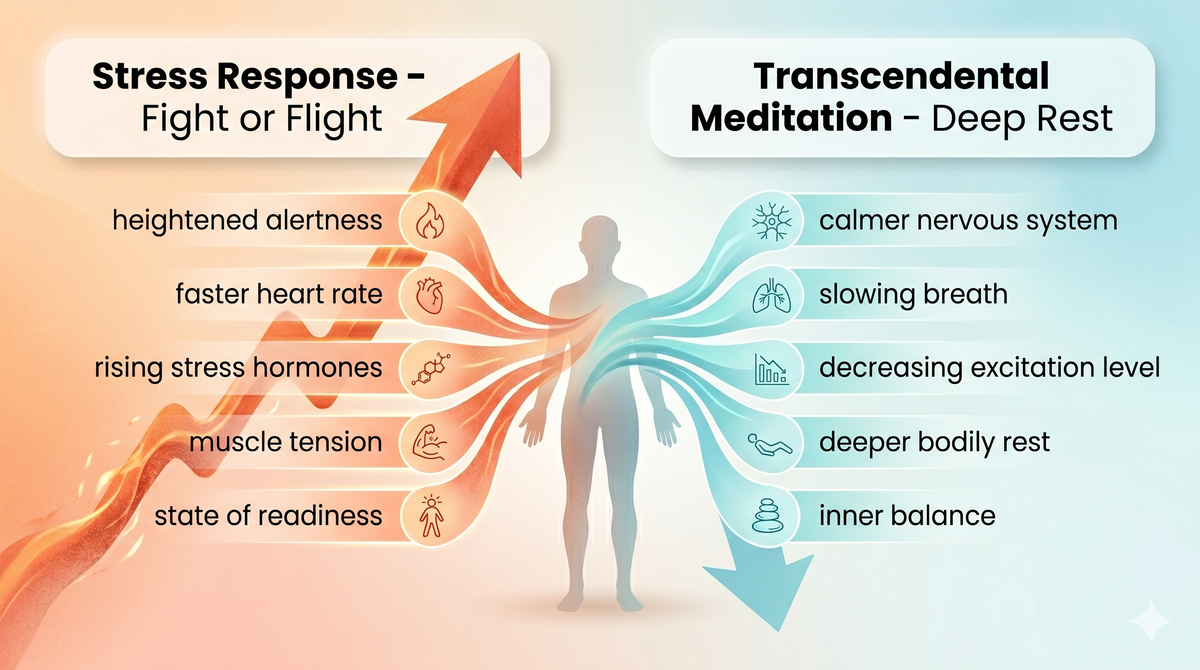
TM isn’t sleep, isn’t concentration, isn’t self-hypnosis, isn’t positive thinking. It’s more of a natural process in which the quieting of the mind allows the body to rest more deeply. And most importantly: you don’t have to convince the body to calm down. You don’t have to hold an internal meeting with the nervous system:
Dear sympathetic nervous system, please tone down your activity for the day.
The process is more natural than that. As if the body finally received the simple message: no need to fight now, no need to flee now, now you can simply settle.
It’s not that TM “switches off” the stress system — we need that system. It’s more that regular practice can support the body’s return from a state of chronic alert toward calm. The American Heart Association’s 2017 statement also puts it carefully: meditation can be a useful complementary tool for reducing cardiovascular risk, but it does not replace proven medical treatments. (ahajournals.org)
A simple picture
If I had to sum it up in a sentence:
The fight-or-flight response says to the body: “There’s danger. Get ready to survive.” The deep rest of Transcendental Meditation seems to say: “The danger has passed. You can start to recover.”
There will be emails. There will be deadlines. There will be people who weigh their bakery croissants with philosophical depth. But if the baseline tension comes down, you don’t need to summon the caveman for every situation.
Sometimes the present, calmer, more clear-sighted human is enough. And in itself, that is already a big evolutionary step forward.
Behind the stress response are the sympathetic nervous system, the adrenaline–noradrenaline system, and the HPA axis; in the short term these support adaptation, but with sustained activation they put a strain on the body. (PMC)